 Posted by
 Co-Development Software The Smarter Way to Build and Scale Projects

Technology is more fluid than ever and companies are under the consistent pressure to provide reliable and scalable software at any time. Not all companies have the time, the scale of workforce, or technical profundity to get it to happen solo. Co-development software is precisely where this takes place- a paradigm of partnership, not outsourcing.
Co-development allows your internal team to collaborate with outside professionals instead of giving all your project to an external vendor. It is a win-win game: you retain ownership of your vision but benefit because with a specialist in your team, you can access specialized skills and additional capacity where it is most needed.
What is Co-Development Software?
In its fundamental form, co-development is a collaborative form of software development. Your company collaborates with an external development partner to plan, design and execute projects with them. Co-development is based on shared responsibility unlike outsourcing that tends to separate the teams. Both share knowledge, resources and effort. You may also Like: Database Browser
This would be a great method in case your organization:
Requirements to expedite a project launch.
Lacks was an expert in such fields as AI, mobile apps, or cloud solutions.
Desires the freedom without any long-term employment.
The outcome is more efficient, quicker and powerful development process.
Why Businesses Choose Co-Development.
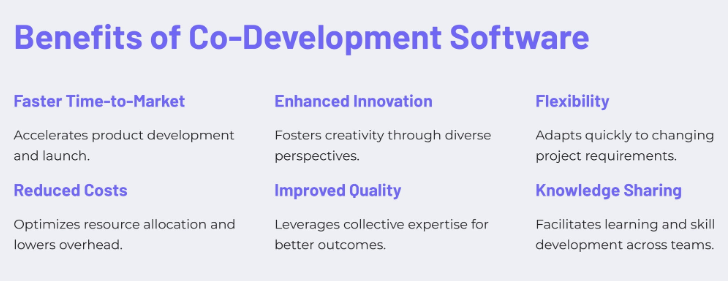
Companies of all sizes are increasingly turning to this model because it solves several real-world challenges. Here are the most important advantages:
1. Speed to Market
By combining your team with external developers, work can progress in parallel. This shortens development cycles and helps you launch products or updates much faster.
2. Availability of Specialization.
Each project is different. Through co-development, you can readily tap into experience in domains not covered by your in-house group- be it AI, cybersecurity, or blockchain.
3. Flexible Scalability
The requirements in a project tend to vary in the middle. Co-development enables you to dynamically expand or contract your team according to the demand without the pain and burden of hiring or dismissal.
4. Cost Optimization
It is costly to build and retain an in-house team of all skill sets. Co-development saves on overheads such as infrastructure, recruitment, and long-term salaries and is, therefore, an economical option.
5. Improved Collaboration
The collaboration in the form of a single team guarantees a greater level of alignment and a reduced number of misunderstandings. Using the current project management tools, the two parties can be able to monitor the progress and exchange updates in real time.
6. Lower Risk
An experienced partner brings proven frameworks, quality checks, and risk management practices. This reduces the chances of errors and ensures smoother delivery.
7. Focus on Core Priorities
While technical tasks are handled by the development partner, your team can focus on strategy, customer engagement, and scaling the business.
How Does Co-Development Work?
The process is usually straightforward and structured:
Planning and Requirement Gathering – Your goals, timelines, and features are defined.
Team Formation – A blended team is created, combining internal staff with external specialists.
Agile Execution – Work is carried out in iterations, allowing flexibility and adjustments along the way.
Regular Feedback – Continuous updates and reviews ensure everyone stays aligned.
Delivery and Long-Term Support – After launch, the partner often provides updates, bug fixes, and ongoing support.
This model ensures projects stay efficient and adaptable from start to finish.
Who Can Benefit from Co-Development?
The beauty of co-development software is that it works for a wide variety of businesses:
Startups – Speed up product launches without building a full internal tech team.
Small and Medium Businesses – Gain access to advanced technology and expertise without overspending.
Enterprises – Expand development capacity quickly for large or niche projects.
Tech Companies – Even established firms use co-development to explore new technologies or handle overflow work.
Best Practices for Co-Development Success
In order to have maximum out of co-development software, remember:
* Select the appropriate partner – Select demonstrated experience, technical expertise and excellent communication.
* Specify early expectations – Have clear goals, deliverables and deadlines.
* Communication should be kept open -Trust and alignment is achieved through frequent meetings and updates.
* Use Agile approaches – Agility development is flexible and quicker.
Knowledge sharing should be encouraged -Both teams must learn to empower the partnership.

FAQS:
1. How is co-development different from outsourcing?
Outsourcing usually hands the entire project to an external team, while co-development involves working together with a partner. You keep more control and visibility over the project.
2. Is co-development only for large companies?
No. Startups and SMEs benefit greatly because it gives them access to skills and speed they might not otherwise afford.
3. What types of projects are ideal for co-development?
Co-development works best for projects requiring rapid delivery, specialized expertise, or flexible scaling—such as mobile apps, AI tools, or enterprise platforms.
4. How do I ensure smooth collaboration with a co-development partner?
Choose a partner with a transparent communication process, clear documentation, and experience in Agile or similar methodologies.
5. Does co-development save money?
Yes. By sharing resources and avoiding long-term hiring costs, businesses typically reduce expenses while maintaining quality.
Conclusion:
Co-development software offers businesses a modern way to innovate faster, reduce risks, and access world-class expertise without losing control. It’s not about replacing your team—it’s about strengthening it.
For organizations that want to grow without being slowed down by limited resources, co-development is no longer just an option—it’s a competitive advantage.
